[wpforms id="617"]

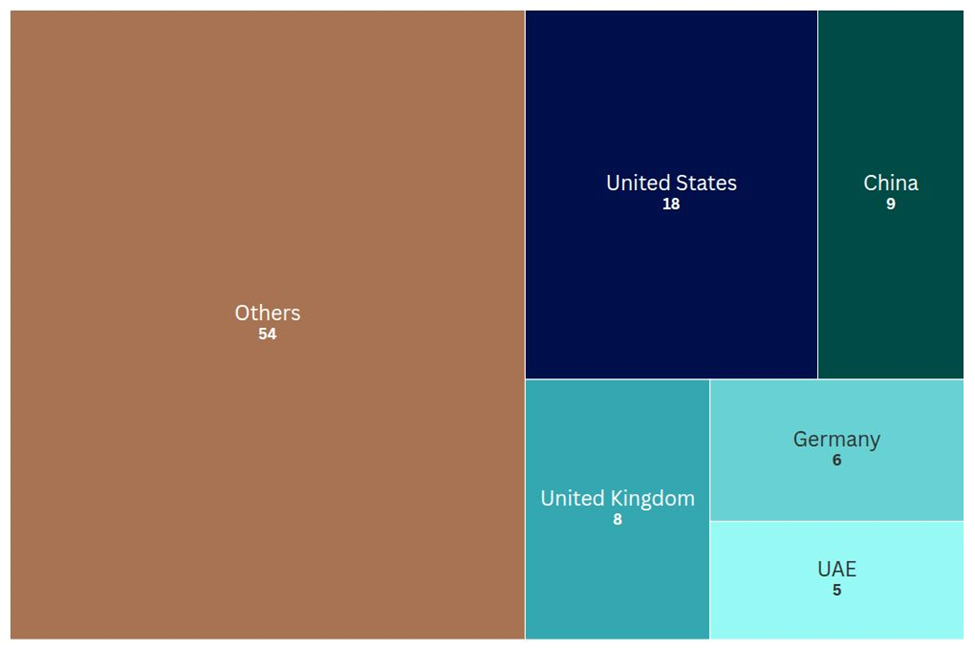
In 2024, Pakistan shipped approximately $32.5 billion worth of goods globally—a 12.1% increase from the previous year. But the real story isn’t just the growth; it’s the concentration. Our interactive Voronoi map reveals how just a handful of nations control the pulse of Pakistan’s economic future.
The “Key Takeaways” (Why this matters)
- The Unshakable Trio: The United States ($5.6B), China ($2.4B), and the UK ($2.1B) remain the massive “anchors” of the map. Together, they represent over 30% of our total export volume.
- The Growth Champions: While traditional markets are stable, Singapore saw a massive 244% growth in imports from Pakistan last year, followed by Kazakhstan (+157%). These represent the “Emerging Blocks” in our Visual Strategy.
- The Resilience of the “Others”: The 54% “Others” block is where the future lies. This category is fragmented into over 100 countries. For a stronger economy, we need more of these smaller blocks to grow and “break out” into major partners.
- Sector Dominance: Textiles remain the king of the map at $16.3B, but the rise of Food exports ($7.1B) and Information Technology is slowly changing the shapes of these blocks.
The Data Table (For the Researchers)
| Rank | Partner | Value (2024/25) | Share (%) | Growth Trend |
| 1 | United States | $5.61 Billion | 17.3% | Stable |
| 2 | China | $2.38 Billion | 7.3% | Expanding |
| 3 | United Kingdom | $2.14 Billion | 6.6% | Moderate |
| 4 | United Arab Emirates | $1.76 Billion | 5.4% | Strong |
| 5 | Germany | $1.72 Billion | 5.3% | Stable |
| 6 | Netherlands | $1.60 Billion | 4.9% | Emerging |
| 7 | Afghanistan | $1.51 Billion | 4.7% | Recovering |
The “Visual Strategy” Insight (The BBA Student Perspective)
The Verdict: If we look at the trade map as a living organism, Pakistan is currently “Western-leaning.” To build a more resilient Voronoi map for 2030, our visual strategy must focus on expanding the size of the Middle East (GCC) and Central Asian blocks. Diversification is the only way to protect the map from global supply chain shocks.
Source: State Bank of Pakistan (SBP), Pakistan Bureau of Statistics (PBS), and The Observatory of Economic Complexity (OEC) 2024-2025.